2025 Highlights
During the Christmas holiday, I had the opportunity to go through my end-of-year review ritual again, where I looked back on 2025 and did some “looking forward” to 2026.
I have been doing this ritual for many years now. It is always a great way for me to reflect on the year ending and understand what the most important things to focus on in the upcoming year are (you can find my approach and templates here: https://esilva.net/articles/end_year.
In the following, I share some “highlights” from those reflections, particularly around my professional activities, including the main changes and experiments on work activities in 2025, and some interesting learnings and explorations I did in 2025.
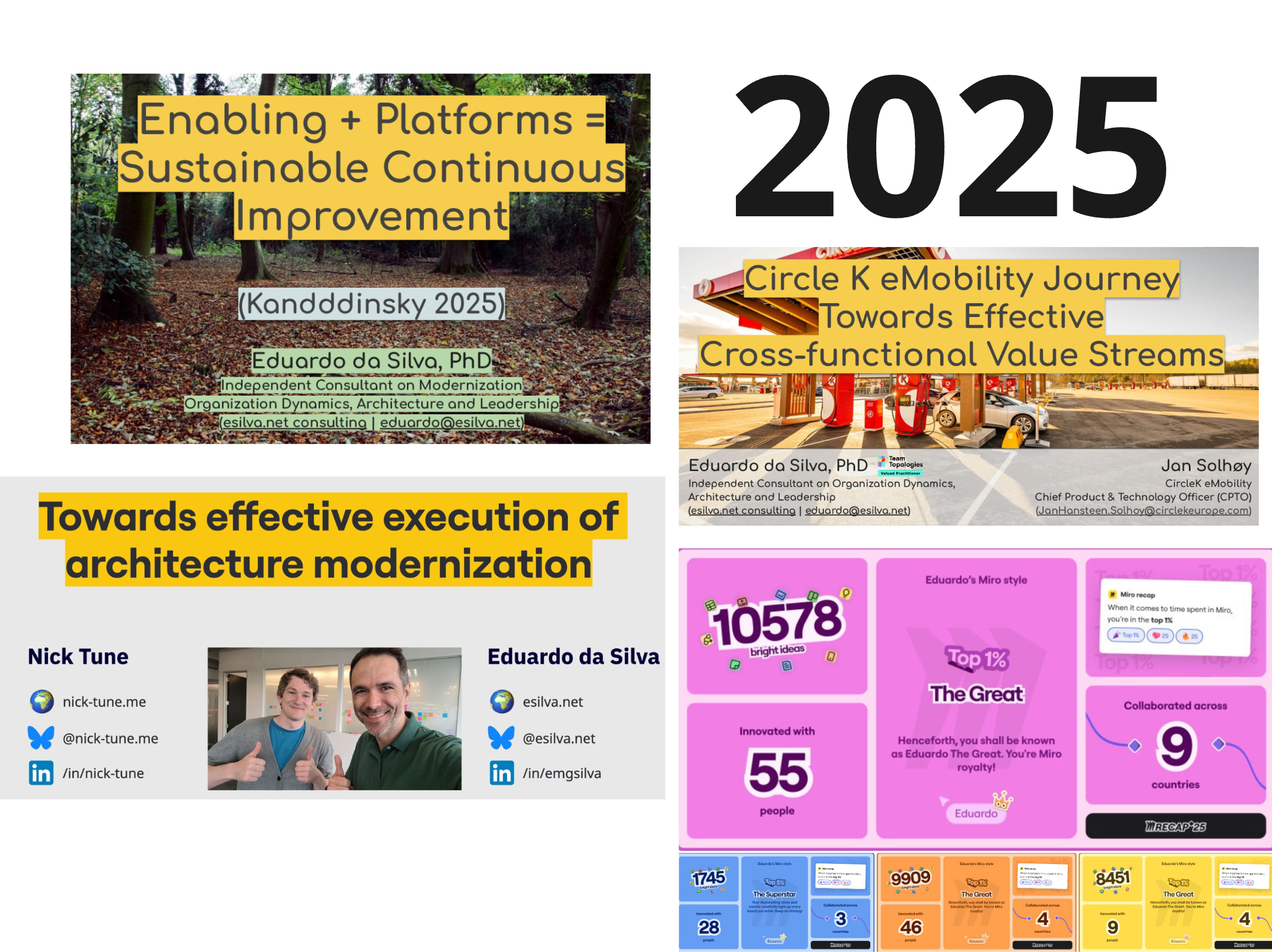
2025 Work Activities Highlights
2025 has been, fortunately, a very busy year professionally. I was fortunate to work with ~10 clients, most of them on small assignments (training workshops, assessments/short advice/consultation, one-on-one coaching sessions, etc.).
Multi-Month/Year Ongoing Enablement
However, this year I also scaled my work with several clients in a multi-month format (in fact, with some clients, I have been engaged for more than a year). I often refer to this relationship as “ongoing enablement” work, and my focus is on helping clients take effective steps to address complex modernization/improvements. This means working with them day-to-day on topics of software organization and systems architecture, organization operations models, leadership, team topologies and dynamics, among many other things that are blocking them in their journeys of modernization and improvement. These are the situations where clients truly benefit from my external expertise to improve on those capabilities and with that become self-sufficient.
This type of work has evolved from the work I used to focus on, a few years back, on “Modernization Kickstarting”. Initially, I would mostly focus on helping clients with the critical steps of kickstarting major modernization initiatives, particularly when they were struggling to get started. Those initial steps have been (and still are) very helpful for many clients. However, I noticed that most clients struggle to take the first steps toward executing the modernization and needed improvements because they lack the capability and skills to do so on their own. So, over the last two years or so, I have refined this product offering (“Modernization Kickstarter Program” - https://esilva.net/products/modernization-kickstarter) to extend those initial steps of understanding where blockers are and what may be some interventions with follow-up “ongoing enablement” activities. On those activities I focus on making sure that the necessary capability improvements take place, so clients can get through those first steps of improvement, kickstart a flywheel of improvement and become self-sufficient to continue improving on their own. Yes, I focus on helping clients to become self-sufficient. I don’t want to become a blocker or dependency for them to work.
If you are interested in learning more about this, you can watch a talk I gave with Nick Tune on this topic at Agile Meets Architecture 2) to extend those initial steps of understanding where blockers are and what may be some interventions with follow-up “ongoing enablement” activities. On those activities I focus on making sure that the necessary capability improvements take place, so clients can get through those first steps of improvement, kickstart a flywheel of improvement and become self-sufficient to continue improving on their own. Yes, I focus on helping clients to become self-sufficient. I don’t want to become a blocker or dependency for them to work.
If you are interested in learning more about this, you can watch a talk I gave with Nick Tune on this topic at Agile Meets Architecture 2025. In this talk, we discuss several elements and patterns of kickstarting and executing this sort of modernization and improvement work. You can check the video and slides below. This talk was yet another highlight of the year: pairing with my friend Nick is always fun - I always learn a lot from the many discussions we get into and tangents we explore together, particularly when prepping our talks.
Another 2025 highlight related to helping customers on their multi-month/year modernization journeys was sharing a field story with a client, namely Circle K eMobility. I did that at FastFlowConf in London with Jan Solhoy (CPTO for Circle K eMobility). In our talk, we shared the journey of the organization, from a startup/lab in Norway, going through the many challenges and improvements, towards a scalable organization and operating model that is now scaling globally. My work with them started in 2023 and has been highly rewarding and impactful, validating my multidimensional mission as an independent consultant: “helping tech organizations modernize dynamics, architecture, and leadership to achieve fast flow of value sustainably.” You can check our talk below.
Coaching Leaders and Leadership Teams
In terms of work activities, a final highlight from 2025 is the scaling up of coaching for leaders and leadership teams I had, and how amazing and rewarding that work has been. Over the past few years, I’ve observed that when working with organizations, I typically engage with teams that own the systems in need of improvement. However, in enterprise settings, we often have many teams and areas/domains, with many dependencies and a large number of people involved. In those environments, people work across those scopes (teams, team-of-teams, etc.), often under immense pressure and with little support to address their challenges effectively.
In 2025, I had the opportunity to coach and advise several organizations on these topics. I can say this was a very successful experiment (I am now collecting some “testimonials” and will soon publish them on my “Enabling Leaders Coaching” page: https://esilva.net/products/enabling-leaders-coaching).
The main takeaway is how impactful it is to help leaders improve their thinking, practices, and tools. Some examples: help introducing things such as “Advice Process” and position the Staff+ Engineers “network” as an Enabling Function in a scale-up with 50+ product teams; another one was to support a SocioTechnical Leader of well established company on several different organizational and team topologies challenges, and help evolve his organization, teams, leadership dynamics and operating model. The outcomes of this work manifest slowly, but over time, we can see how impactful it is across multiple teams and the entire organization. It is crucial to realize that if they have better ways of intervening and facilitating improvement in their scopes of work, their impact is immense, or, as Pat Kua often says, “they have a multiplying impact”.
I feel privileged to do this work, and I look forward to doing even more in 2026 and beyond.
2025 Learning Highlights
In terms of research, learning, and writing new ideas, 2026 was less busy than previous years, as I was busier with day-to-day client work. Still, I continued exploring several topics and ideas, and I had the opportunity to present several of them at conferences in 2025. I will also be publishing several articles on those topics in 2026. In the following, I highlight two topics. However, there were several other smaller items (many were “spin-offs” from the work activities highlighted in the previous section), such as learning from the challenges I see with my clients, which is my preferred way of learning.
Enabling Activities + Platforms = Sustainable Continuous Improvement
I have been exploring the topic of Enabling Teams and “Enabling Work/Activities” for many years now. When the Team Topologies book was released 5+ years ago, I had many discussions with Manuel and Matthew on those topics. I even created a video course on “Effective Enabling Teams” (you can find it here: https://academy.teamtopologies.com/courses/effective-enabling-teams).
In this period, while working with different companies, I also started noticing several interesting patterns around the “Enabling Work” - the work that Enabling Teams do, but also individual experts often do, without effectively having to be named an official enabling team. In particular, I noticed that the enabling work and activities are highly effective at addressing new challenges that require capabilities that are not yet well developed within organizations. If organizations allow the people who know the most about those topics to accelerate learning and improvement across several teams that need to be more effective in leveraging that new capability, the organization’s overall effectiveness will improve.
However, what I also noticed was that this enabling work/activities tends to reach a limit at a given point. Those experts will not be able to effectively support everyone who needs the new capability. When this happens, they can become a blocker to its effective scaling.
This is a strong signal to introduce platform support for that emerging capability, particularly when initial experiments show it is highly valuable to teams building customer value.
Such an organizational dynamics pattern, of Enabling work (as a means to address new challenges, validate and frame capabilities) and Platforms (as a means to scale validated capabilities for the whole organization), is one of immense potential. I have been exploring this topic for a few years now and gave a talk about it in the 2025 Kandddinsky conference (check the slides below). Stay tuned for a deep-dive article on this topic soon.
Architecture Topologies
In 2025, I continued developing my Architecture Topologies work (https://esilva.net/architecture-topologies), which I have been shaping since 2020/2021.
I had the pleasure of giving several talks and workshops on this topic, and I continue to learn and improve it every time I do such events. Some highlights from last year were:
- Architecture Topologies are not about Architects; it is about Architecture Capability in teams, across teams, and across the whole organization.
- Although many people argue we don’t need Architects, the fact is that when they have the right incentives, mandate, and positioning, they can be enormous enablers of organization improvement - often towards Architecture Topologies where the organization may not need any Architects (sounds odd, but this can happen).
- “Enabling Architects” (a term/idea I introduced in 2021 - https://esilva.net/tla_insights/architecture-topologies) still seems to be one of the most effective moves (“Next Best Action”) that most enterprises can take in improving their Architecture Capability. This is often confusing for Chief Architects and Senior Leaders - “How can we let the power go?”; “Teams are not capable of doing this”, etc. (I have heard many variations of these stories). However, the bottom-line is: when more knowledgeable architects are not just “controlling the architecture work”, but also facilitating teams improving their architecture capability (i.e., ability to own and do architecture themselves), the overall architecture capability improves over time, and we stop having single Enterprise Architects (and teams) driving this work - which, by now we know does not scale, and does not allow for more effective designs and architecture, since that happens more effectively when the people close to the problems are involved.
These were just a few highlights; there were many more. I have a deep-dive article on the works, which should come up sometime in 2026, where I will try to articulate many of these ideas, as I am sure this topic of “how are we approaching architecture and improving architecture capability in organizations” is and will continue to be a very important topic.
Looking Forward to 2026
I am really excited about what is coming up in 2026. I will continue working on several initiatives I started in 2025, but I will also explore several new ones.
In particular, I want to again spend some time “researching and learning” about important topics for my work, and then consolidate those ideas into writing and possibly some new talks. This is something I love doing, as this helps me organize my learnings and ideas.
I also look forward to continuing to collaborate with many amazing people, many of whom I consider very good friends, in several projects.
In 2026, I also plan to explore some new product offerings, particularly around training and coaching.
I wish you a fantastic 2026.
P.S. I wrote this entire text without any AI-generated content. I have been increasingly exploring AI in recent times (and how I can leverage it on my work - there are a lot of interesting ideas on how to explore it as a tool to support humans accelerating some activities). Still, I still think for this sort of reflection one needs to spend time alone, thinking deeply on things, so we understand what matters and how we should move forward. Again, if you also want to do a similar end-of-year reflection, you can check that here: https://esilva.net/articles/end_year