Book Review: Human software
“You can tell the mood of the systems from the people who are supporting it. That is what true legacy is, it’s the human history of the company.”
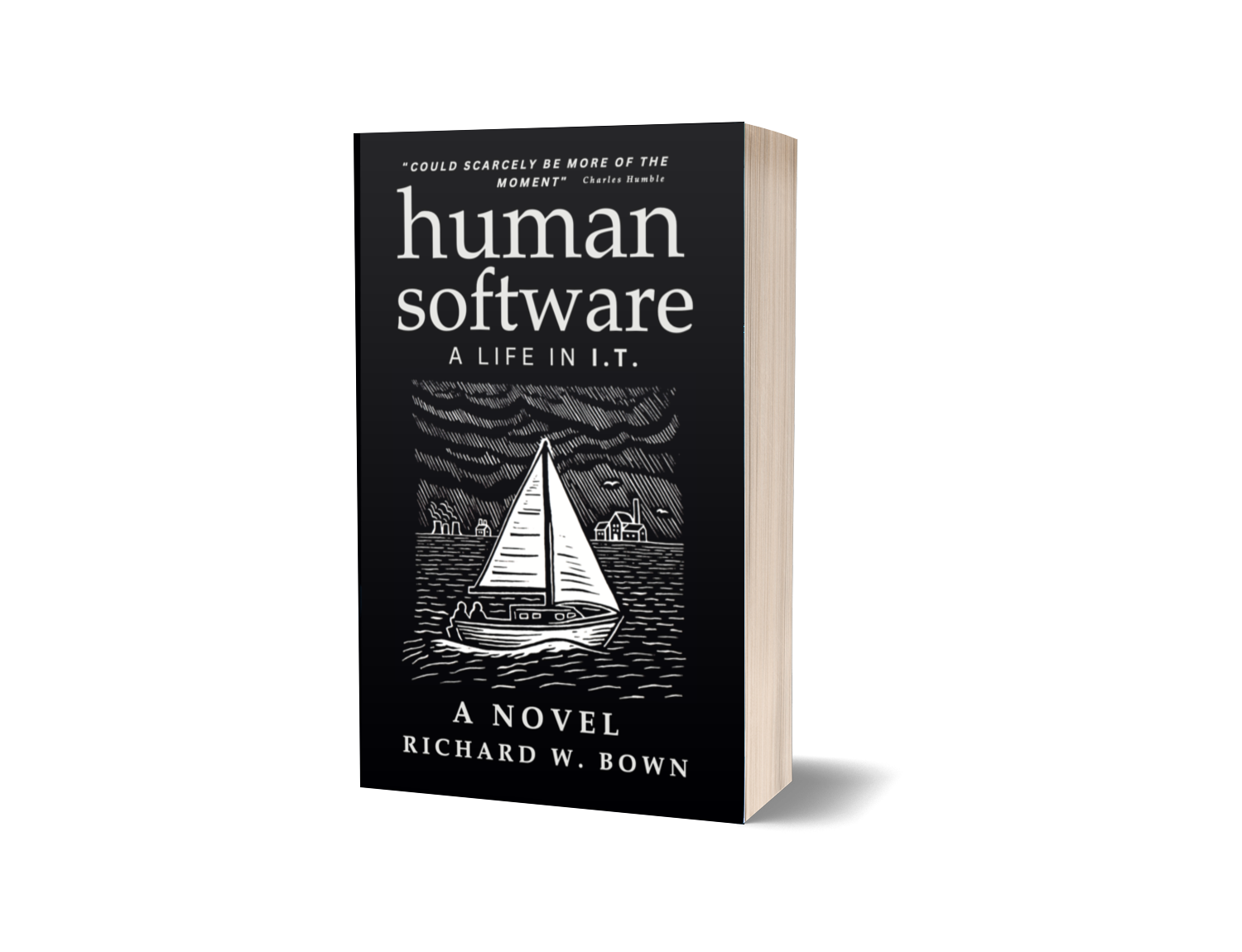
I recently read Human Software, an “IT novel” by Richard W. Bown. The novel shares some similarities with the classics, The Phoenix Project and The Unicorn Project, exploring the adventures of several people working in IT and going through large and critical “IT Transformations”. However, Human Software has a rather unique style. I would say it feels much more “realistic and dark”. In a sense, the “Britishness” of the author transpires, compared with the more “positivist American style” of the other two novels. I love all of these books, and knowing the authors, I find their personal style details very interesting.
The novel takes place in a small fictional coastal town in South-East Kent, UK. The story is about a group of employees at a large American logistics and distribution company called “Gerbach”. These people work in different functions and are responsible for the IT systems and (software-enabled) products of the company. This is a decades-old company, and the book explores the challenges of maintaining and evolving those systems in a rather unhealthy environment, where incidents occur randomly due to their poor quality and the lack of attention. This is, unfortunately, a relatively familiar place, but the way this is written and articulated will have you turning pages and guessing what comes next.
The story shows the “suffering” of people working on the ground, for many years, trying to keep “the lights on” and somehow improve the systems in place. However, that is difficult when you have “leadership” that keeps coming in with unrealistic, disconnected ideas, which destroy the ability to actually evolve the technical (and social) systems in the organization. In this topic, the book explores a rather current topic: the explosion of AI and how many organizations are blindly pushing its adoption without considering their context. I would say this is a key lesson from this novel: how messy organizations can get even messier when they don’t sense and consider their context (technical, social, strategic, etc.). I love how Richard makes this point so “painful” at times, but also very realistic (this is a novel, but I am sure many people will say, “Yeah, I have seen this before”).
I also appreciate the exploration of the “human side” of the characters. The stories and struggles of the people behind the technical systems - something we don’t often see discussed. The book explores many unhealthy social dynamics and practices that people often develop to cope with the culture and incentives that emerge within organizations.
The book is naturally fiction, but the stories of misunderstanding, of neglect (of technical systems, the many incidents they end up having, and the people who take care of it) are real. The stories of poorly approached modernization work and its balancing with “promise of unrealistic innovations, with equally unrealistic deadlines” also will resonate with many people. Still, it is not just about painful topics. The author elaborates on many interesting ideas on how things could be better. There are definitely ways to improve, but they are not free and require leadership that is not focused solely on going fast or is too distracted by new shiny things.
I highly recommend this book to any IT/Tech professional. In particular people in (or growing into) positions of leadership (technical, but also other disciplines, in fact any discipline because today every company is a tech-enabled company, it is a fact, not an option). The book is full of lessons and insights that can be considered and applied to help build more “humane organizations”. Organizations that can evolve more sustainably, avoiding the many anti-patterns and poor practices that many organizations end up creating over time, particularly to learn that humans are essential to build the right software right.
You can find the book, and many other related resources, here: humansoftwarebook.com